Loans as an Asset Class
Why FinTech loans need an investor lens, and the steps from loan data to cashflows.
Shipra Mahajan2 min read
Post-Financial Crisis, unsecured consumer loans have emerged as an investable asset class driven by the emergence of FinTech lenders. Historically, banks would "originate to hold," earning an interest spread versus the cost of deposits. FinTech lenders, on the other hand, typically "originate to sell," earning origination fees, servicing fees, and any gain on loan sale.
Loan buyers span the spectrum: banks and credit unions (funded by deposits), institutional investors (private credit, asset managers, hedge funds, family offices), and capital markets (securitizations backed by pension funds, insurance companies, asset managers). FinTech lenders historically catered to retail investors, though they now constitute a minuscule proportion of the loan investment landscape. More recently, some FinTechs have emerged as hybrid banks that accept deposits alongside loan sales. Nonetheless, loan buyers are a critical component of FinTechs' funding strategy.
From a balance sheet view to an investor view
This shift creates the need to look at credit from an investor lens versus a balance sheet view:
- Portfolio view → Vintage view
- Net interest margins → Portfolio spread
- Customer acquisition costs → Purchase pricing (par / premium / discount)
- Operating expenses → Servicing fees
- Collection costs → Collections fees
- Loss reserves → Duration risk and loss protection
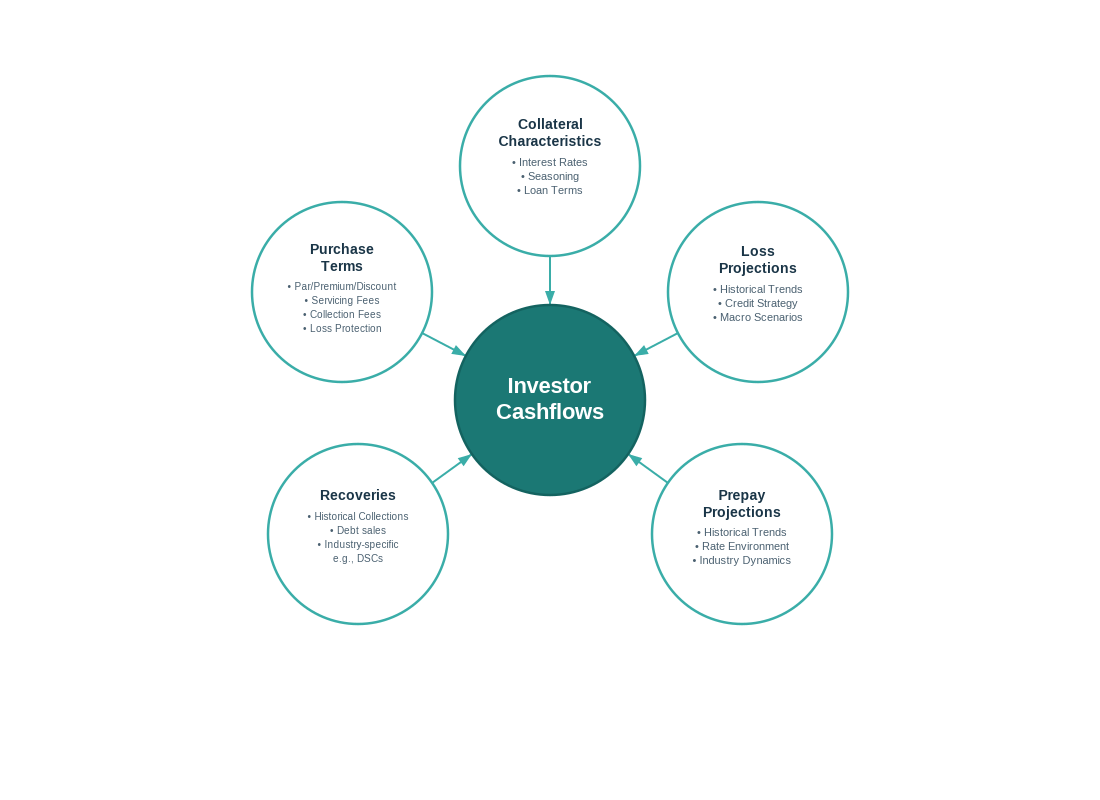
…even as the fundamental credit building blocks remain the same:
- Collateral characteristics: interest rates, loan terms, and seasoning
- Loss projections: the timing of the curve is critical to intermittent investor purchases, unlike a loss level rate for stable portfolios
- Prepay projections: timing and magnitude of prepay expectations over the lifetime of the collateral
- Recoveries: pre-charge-off collections and post-charge-off recoveries
From credit to investor credit
Given all the above input assumptions, the transition from traditional credit to investor credit is accomplished through the following steps.
- Segmentation. Categorize all purchased loans into homogeneous segments based on major dimensions like origination vintage, risk tier, term, and seasoning. The key is to ensure that each segment is cohesive in terms of expected loss and prepayment behavior.
- Segment-level cashflows. Each segment has an investor outflow at the time of purchase based on the purchased balance and pricing (par / premium / discount). Going forward, every billing cycle (or calendar period, depending on terms of trade) has an associated scheduled payment based on the interest rate and loan term. This can be combined with expected loss and prepayment each cycle to estimate asset-level cashflows. With a final overlay of recoveries (net of associated fees) and servicing fees, these are converted into a series of net investor inflows over time.
- Portfolio-level cashflows. Segment-level cashflows can then be added at each time period to create portfolio-level cashflows.
- Summary metrics. Investor-relevant metrics — primarily IRR (internal rate of return), ACL (annualized credit losses), and duration / WAL (weighted average life) — can then be estimated from the cashflow series.
In the coming articles, we will take a deeper look at each of these elements, from portfolio segmentation and cashflow modeling to projecting losses, prepayments, and recoveries.